Aviation does more than move people and cargo. It connects businesses to markets, families to opportunities, and destinations to visitors. For Pakistan, developing these connections can support trade, tourism and employment—but realizing their full value also requires a skilled workforce.
Aviation and economic opportunity
Economic growth and air connectivity can reinforce one another. Growing economies create demand for air travel, while reliable air services can help businesses reach customers and visitors reach new destinations.
The contribution is substantial. The Air Transport Action Group estimated that in 2023, aviation and aviation-enabled tourism supported 86.5 million jobs and US$4.1 trillion in global economic activity. This estimate includes wider activity supported by the sector, not just airline and airport operations. Aviation Benefits Beyond Borders
These benefits do not arise from aviation alone. Good governance, investment, infrastructure and a stable economic environment all influence whether countries can turn connectivity into lasting opportunity.
Why specialized education matters
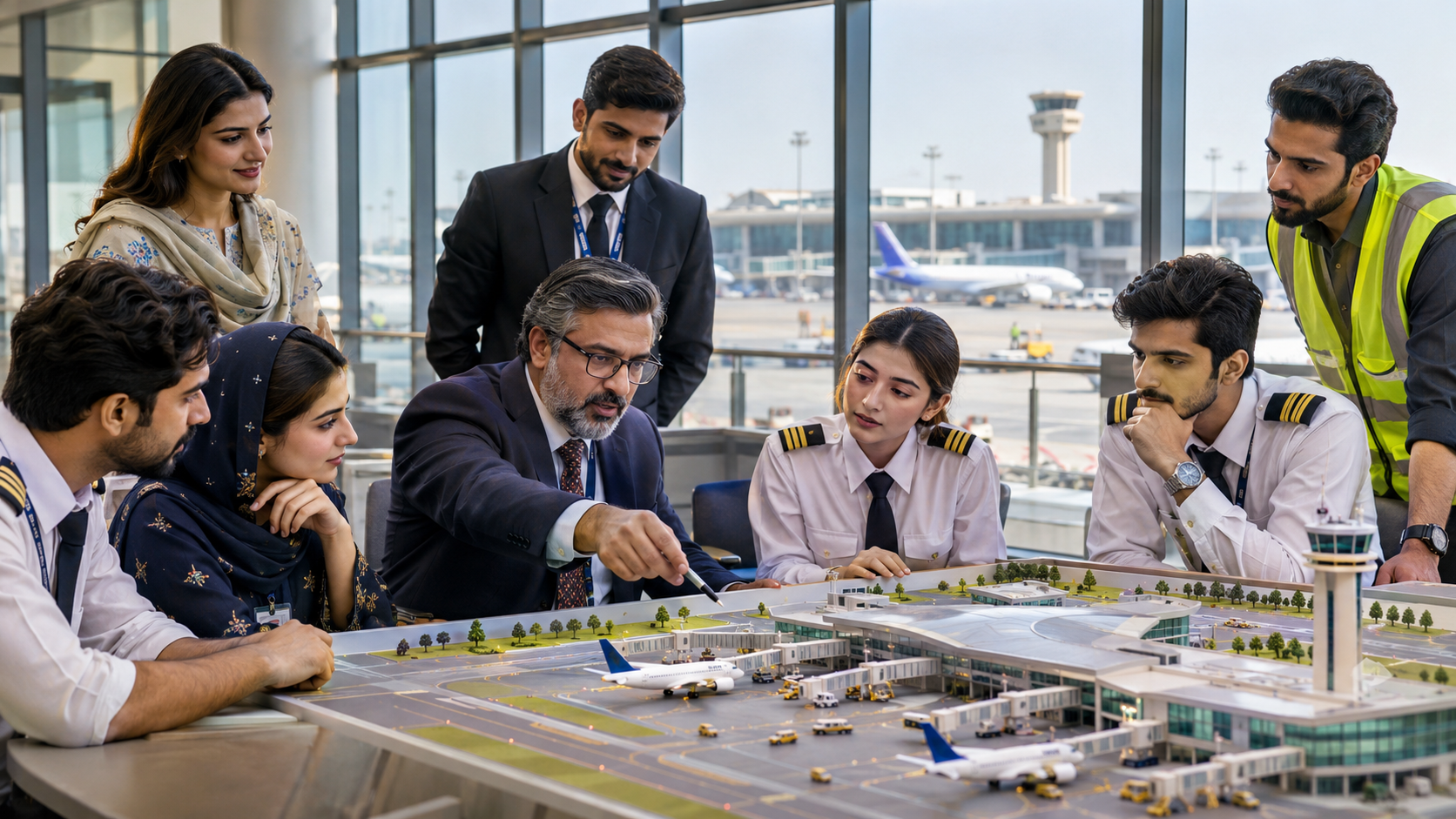
Aviation is a regulated, technology-intensive industry that depends on people with specialized knowledge. Its workforce extends beyond pilots and cabin crew to include airport managers, maintenance technicians, air traffic professionals, safety specialists, cargo planners and data analysts.
Education and training help prepare people for these roles and adapt to changing technologies and operational requirements. The International Civil Aviation Organization emphasizes cooperation among industry, educators and governments to attract and develop future aviation professionals. icao.int
An opportunity for Pakistan
IATA estimates that in 2023, aviation and the wider activity it supported—including supply chains, employee spending and tourism—contributed US$5.6 billion to Pakistan’s GDP and supported 683,900 jobs. These are estimates of the sector’s broader economic footprint, not just direct aviation employment. iata.org
Pakistan can build on this contribution by connecting aviation policy with education, trade, tourism and investment. Schools can introduce students to the range of aviation careers, while universities, airlines, airports and regulators can work together on relevant courses, internships and practical training.
Investing in people
Aircraft and airports are essential, but they need capable people to operate, manage and develop them. By improving career awareness and access to aviation-specific education, Pakistan can prepare more of its people to participate in the sector and strengthen the foundations for wider economic opportunity.
Sources
Original article: Connectivity to Prosperity: Why Aviation Specific Education Matters — article text supplied by the author.
Air Transport Action Group: Aviation: Benefits Beyond Borders — global estimates for 2023.
IATA: The Value of Air Transport to Pakistan — Pakistan estimates for 2023.
ICAO: Next Generation of Aviation Professionals Programme — aviation workforce development.