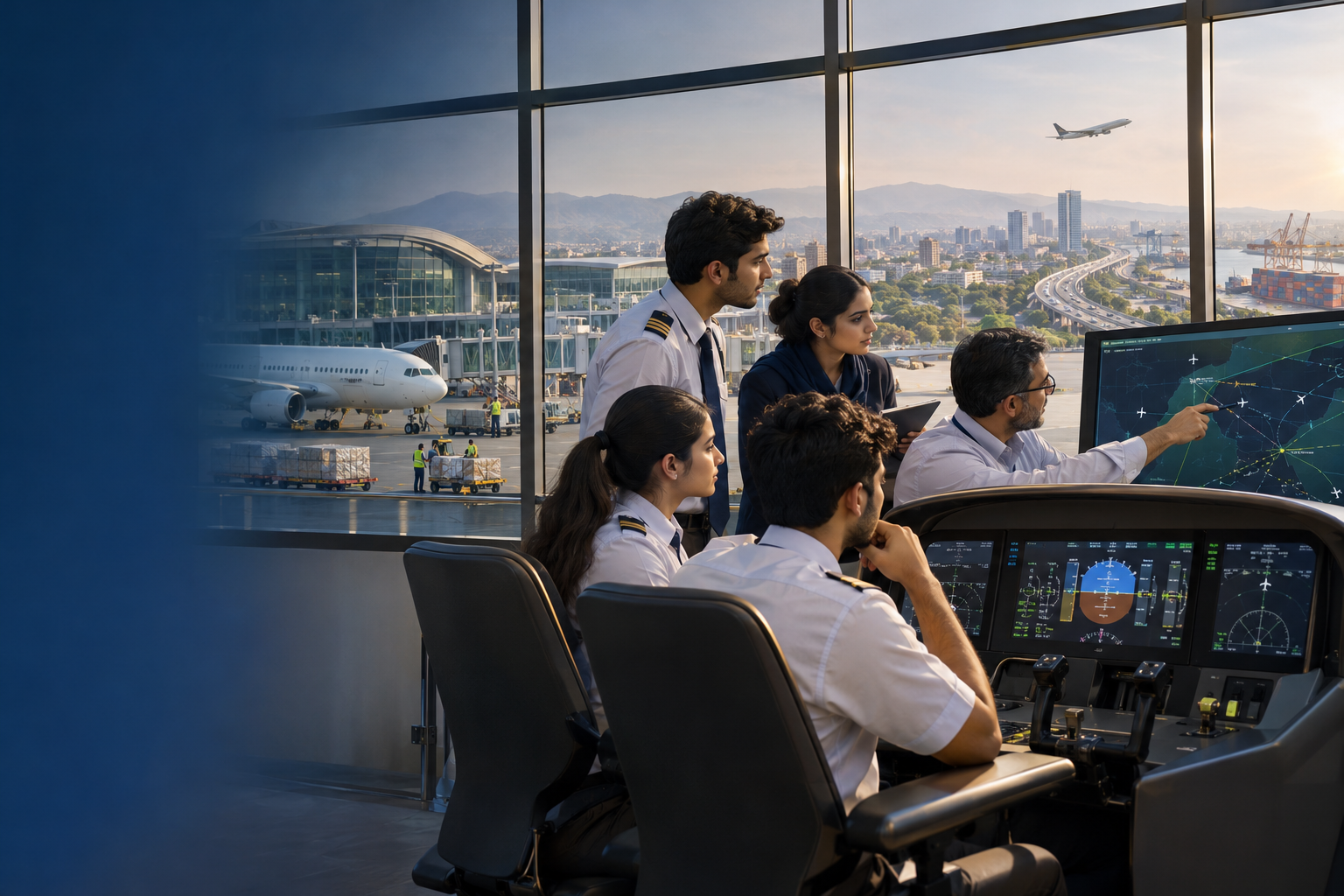
Aviation education in Pakistan is not simply a pathway to a career in the air. It is a national capability. When a country develops aviation connectivity, institutions and skilled people together, it expands the conditions for trade, tourism, investment, productivity and social mobility. Aviation does not only carry the benefits of prosperity; with deliberate planning, it can help create them.
That distinction matters for Pakistan. The country has a large and youthful population, a strategic location, an extensive diaspora, important religious and tourist destinations, and growing needs in trade and logistics. These are not guarantees of aviation success. They are reasons to build the knowledge, institutions and talent that can convert potential into practical opportunity.
Aviation is economic infrastructure
Air transport connects businesses with customers, exporters with markets, universities with students and communities with opportunity. It also supports access to healthcare, disaster relief, education and remote areas. The economic case is substantial: in 2023, aviation and aviation-enabled tourism supported an estimated US$4.1 trillion in global economic activity and 86.5 million jobs. Aircraft also carried roughly 61.4 million tonnes of cargo valued at about US$8 trillion, representing 33% of global trade by value.
These figures do not mean that aviation alone causes economic growth. Sound governance, infrastructure, investment, industrial capacity and macroeconomic stability remain essential. But aviation can be a powerful enabler when it is treated as part of a wider national development system rather than as a stand-alone transport service.
What successful aviation ecosystems teach us
Countries that have strengthened their aviation position did more than build airports or acquire aircraft. They developed connected ecosystems: regulation, education, safety, cargo, maintenance, technology, finance, tourism, airport management and international market access.
Singapore demonstrates how connectivity can become a strategic asset even without a large domestic market. Its aviation ecosystem reaches beyond airline operations into airport management, cargo, aerospace engineering, maintenance, regulation, training and technology. The United Arab Emirates followed a similarly integrated model, linking airports and airlines with tourism, logistics, global events, real estate, services and international commerce.
The lesson for Pakistan is practical. Aviation planning cannot be isolated from trade, tourism, education, digital capability, urban development and investment policy. A successful sector is built through institutions and people as much as through physical assets.
The next aviation challenge is people
Demand for aviation is expanding worldwide, and the pressure on the talent pipeline will intensify. Airports Council International forecasts global passenger traffic could reach 17.7 billion by 2043. Boeing projects that commercial aviation will need approximately 674,000 new pilots, 728,000 new maintenance technicians and 1,023,000 new cabin-crew professionals between 2026 and 2045. That is more than 2.4 million people before counting the many professionals needed in airport management, planning, safety, air traffic services, cargo, law, cybersecurity, sustainability, data analytics and regulation.
For South Asia, the opportunity is especially significant. A large young population can become a competitive advantage only when education is aligned with the real capabilities the sector needs. If countries wait until demand is visible, the opportunity may already have moved elsewhere.
Why aviation-specific education matters
Aviation is global, regulated, technology-intensive and safety-critical. General education builds important foundations, but it cannot alone provide every competency required by the sector. A modern aviation workforce needs relevant knowledge across areas such as:
airline and airport operations;
aviation safety, security and regulation;
air traffic and airspace management;
aircraft maintenance and engineering;
revenue management, network planning and aviation finance;
cargo, logistics and supply-chain management;
human factors, crisis management and resilience;
data analytics, artificial intelligence and cybersecurity; and
sustainability and environmental management.
Aviation awareness creates educational demand. Aviation education develops professional capacity. Professional capacity enables aviation growth. And aviation growth can support national development. This is why career awareness should begin well before university. Young people and their families need to see that the industry includes far more than pilots, engineers and cabin crew. It also offers routes into safety, operations, cargo, digital systems, regulation, consultancy, entrepreneurship and leadership.
Pakistan’s opportunity
Pakistan’s aviation sector already delivers economic and social value. IATA estimates its total impact at about US$5.6 billion in GDP and 683,900 jobs, including direct activity and aviation-supported tourism. Yet the country’s geography, population, diaspora, tourism potential and logistics needs suggest considerable unrealised opportunity.
The question is not whether Pakistan should copy another country’s aviation model. It should not. The question is how Pakistan can build an approach suited to its own strengths: a connected national strategy, credible education pathways, industry partnerships and a long-term commitment to standards, safety and talent.
Seven priorities for action
Connect aviation to national development. Link aviation policy with tourism, trade, logistics, education, technology, urban development and investment priorities.
Treat connectivity as an economic objective. Assess routes by their contribution to exports, tourism, investment and diaspora links, including viable connections for secondary cities.
Build clear education pathways. Support aviation awareness in schools and strengthen university and professional programmes in management, operations, safety, maintenance, cargo, data and sustainability.
Make careers visible. Give students and parents reliable information about aviation occupations, qualifications, progression and international opportunities.
Design education with industry. Universities, airlines, airports, regulators and training providers should co-develop curricula, internships, simulations and competency-based assessments.
Develop regional talent. Pakistan can prepare professionals not only for its domestic market but also for the Middle East, South Asia, Africa and Southeast Asia.
Build the full ecosystem. Invest in capabilities across airport management, MRO, cargo, flight training, technology, simulation, consulting, ground handling and sustainable aviation.
The route forward
Countries do not become aviation leaders by accident. They recognise connectivity as a national asset, develop specialised institutions, educate their people and maintain a long-term policy commitment. Pakistan has the people, location and demand to become a more important regional aviation market. The next step is a deliberate shift in thinking: aviation should be treated not as a luxury, but as a strategic national capability.
Investing in aviation education in Pakistan is therefore an investment in skilled people, stronger connectivity and a more competitive economy.